

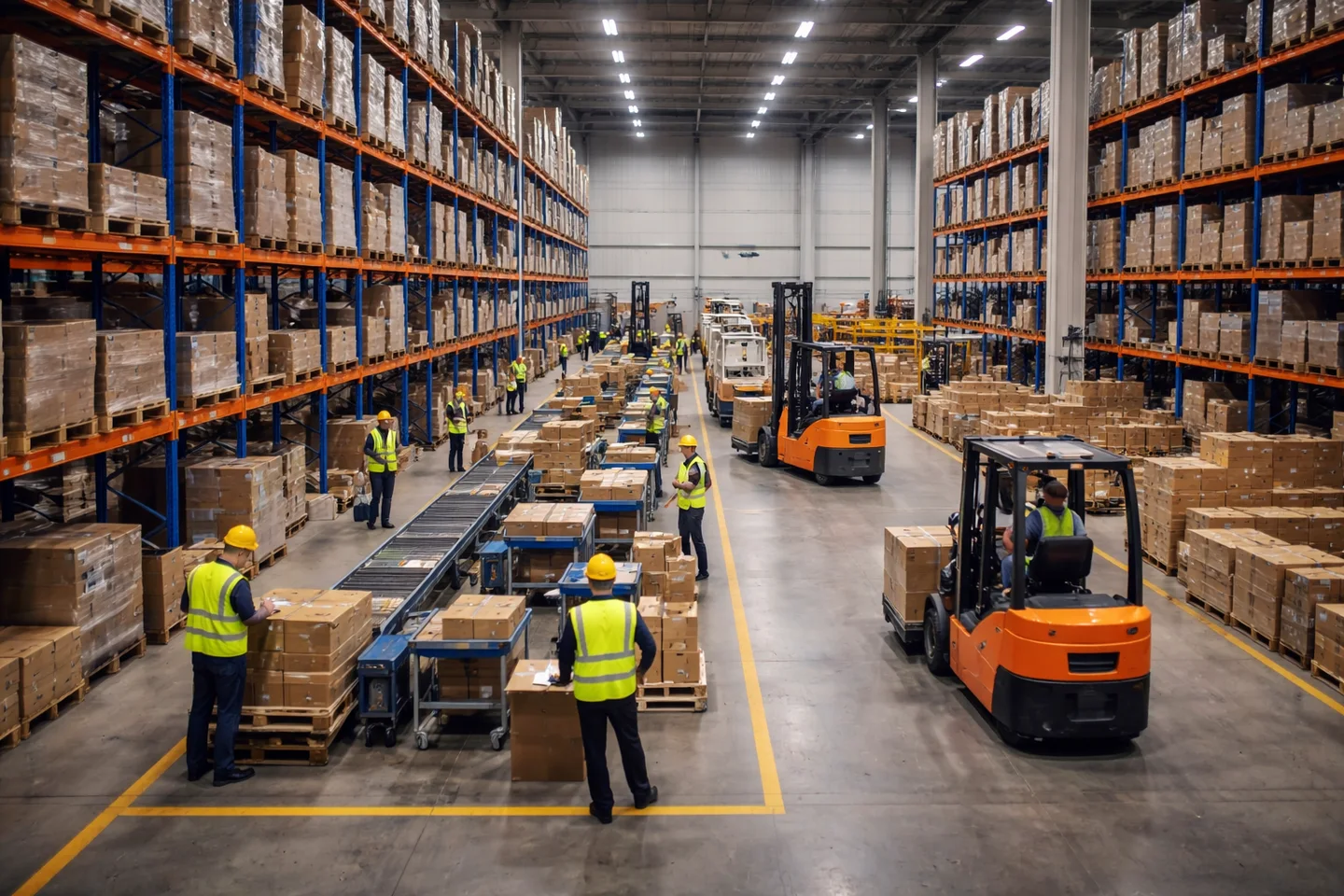
Hello Reader!
When people talk about supply chains, the focus is often on movement — transportation, delivery, timelines.
But in reality, everything depends on what happens inside the warehouse.
From my experience in contract logistics, I’ve come to see that warehouse operations are not just a step in the process — they are the point where control is either established or lost.
Complexity of Operations
On paper, warehouse operations are simple: receive, store, pick, and ship.
In practice, this is where most problems start.
A missed scan, an incorrect put-away, or a rushed picking process may seem minor in the moment.
These small errors compound quickly — showing up later as inventory discrepancies, delayed shipments, or customer complaints.
The challenge is not understanding the process.
It is executing it consistently under pressure.
Organized warehouse shelves with labeled bins
This raises a fundamental question — what actually enables operations to remain stable despite these conditions?
Building the Strong Foundation of Operations
One of the biggest misconceptions is that performance improves by working faster or harder.
In reality, strong operations are built on structure.
A well-designed layout reduces unnecessary movement.
Clear Work Instructions remove ambiguity.
Daily practices like 5S ensure that the workspace remains organised, allowing teams to identify issues early rather than react to them later.
These are not improvements you implement once — they are habits that must be sustained daily.
When structure is in place, operations feel controlled.
When it is not, everything becomes reactive.
Technology then comes in to reinforce this structure — by ensuring execution is consistent and deviations are visible.
Usage of Technology and its limits
Technology supports the foundations already in place.
A Warehouse Management System ensures inventory moves according to the defined layout.
Scanning reduces manual errors and enforces correct execution.
System visibility helps surface issues early, such as missed transactions or incorrect locations.
These tools strengthen control — but they do not replace it.
If the layout is unclear or processes are weak, technology will only expose the problem faster.
Ultimately, systems enhance visibility — but even with the right tools in place, real-world operations introduce another layer of complexity.
Reality - Challenge of Operations
The challenge is not the process itself, but the conditions under which it is executed.
In operations, you deal with:
Sudden spikes in inbound or outbound volume
Urgent orders that disrupt planned workflows
System-related issues affecting transactions
Manpower constraints during peak periods
Under these conditions, the difference between a stable operation and a chaotic one comes down to:
How well processes are understood
How clearly instructions are communicated
How consistently teams execute
This is where leadership becomes critical — not in planning alone, but in guiding execution in real time.
This is where the human element becomes essential.
The Human Element in Operations
One of the most overlooked aspects of warehouse management is the people behind the process.
A strong operation is not built on systems alone, but on how well teams understand and execute within those systems.
In practice, this comes down to a few fundamentals:
Clear communication of priorities
Consistent training and reinforcement
Alignment between leadership and execution teams
From my experience, performance improves significantly when teams:
Understand the purpose behind tasks
Are given clear and consistent instructions
Feel supported during peak or stressful periods
When these elements are in place, execution becomes more stable and predictable — even when operations scale or conditions change.
Operations is not just about systems — it is about people executing systems well.
Over time, this has reshaped how I approach operations and leadership.
What This Has Taught Me
Working in warehouse operations has changed how I approach work.
It has shown me that efficiency is not about speed — it is about control.
It is not about reacting quickly — it is about reducing the need to react at all.
Most importantly, it reinforced that strong operations are built through:
Discipline in daily execution
Attention to detail
Continuous, incremental improvement
These are not one-time efforts, but standards that must be maintained every day.
Final Thoughts on Understanding Warehouse Operations
Warehouse operations may not always be visible, but they are critical to ensuring that the supply chain functions reliably.
When done well, everything flows.
When not, everything feels the impact.
And more often than not, the difference comes down to how well the fundamentals are executed on the ground.
Thank you for reading!